

Project Background
The Watch, Play, Learn (WPL) programme is a play-based early learning intervention implemented by Sesame Workshop South Africa, with support from Standard Bank, to strengthen school readiness among children aged 3–6 in under-resourced Early Childhood Development (ECD) settings.
The programme integrates structured educational media, guided facilitation, and hands-on play activities into everyday classroom routines, supporting the development of foundational skills in socio-emotional learning, literacy, numeracy, and problem-solving.
Delivered through low-tech, scalable models aligned with South Africa’s early learning priorities, WPL aims to enhance both child development outcomes and educator practice, while providing an evidence base for programme refinement and scale-up.
Summary of Findings
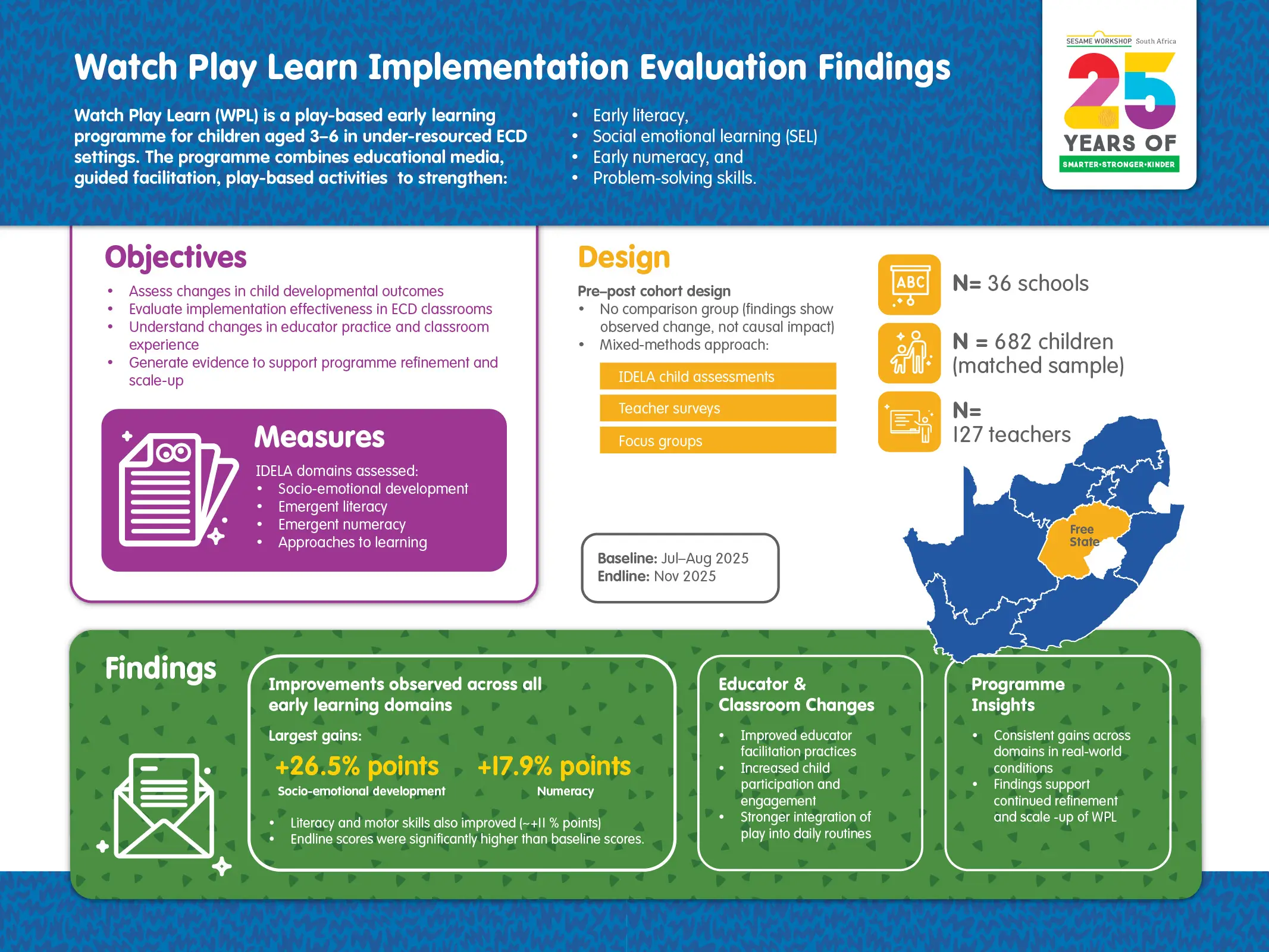
The WPL pilot demonstrates strong and consistent improvements in early childhood development outcomes within real-world, under-resourced ECD contexts in the Free State.
Using a pre–post evaluation design, developmental progress was tracked for a matched sample of 682 children aged 4–6 years between baseline (July–August 2025) and endline (November 2025). Findings show statistically significant gains across all assessed learning domains, with the most pronounced improvements in socio-emotional development and emergent numeracy, alongside meaningful gains in literacy and motor development.
Importantly, the evaluation identified strong equity effects, with children in lower-performing centres demonstrating the greatest gains over time. This suggests that WPL has the potential to reduce early learning disparities and deliver more equitable developmental outcomes in low-resource settings.
In addition to child-level outcomes, the programme contributed to measurable improvements in educator practice and classroom experience. Educators demonstrated increased confidence and effectiveness in facilitating play-based learning, leading to higher levels of child engagement, participation, and interaction during classroom activities.
While the pilot did not include a comparison group, the consistency and magnitude of gains across domains provide strong evidence of meaningful developmental progress attributable to the programme within the implementation context.
Conclusion
Overall, the WPL pilot provides compelling evidence that integrated, play-based learning approaches combining educational media, facilitation, and hands-on activities can deliver measurable improvements in school readiness, while strengthening educator capacity in under-resourced ECD settings. These findings will inform ongoing programme refinement and support strategic decisions on scale-up and future investment.
